The Wall Remembers: A Walker’s Field Guide to Faded Shopfronts
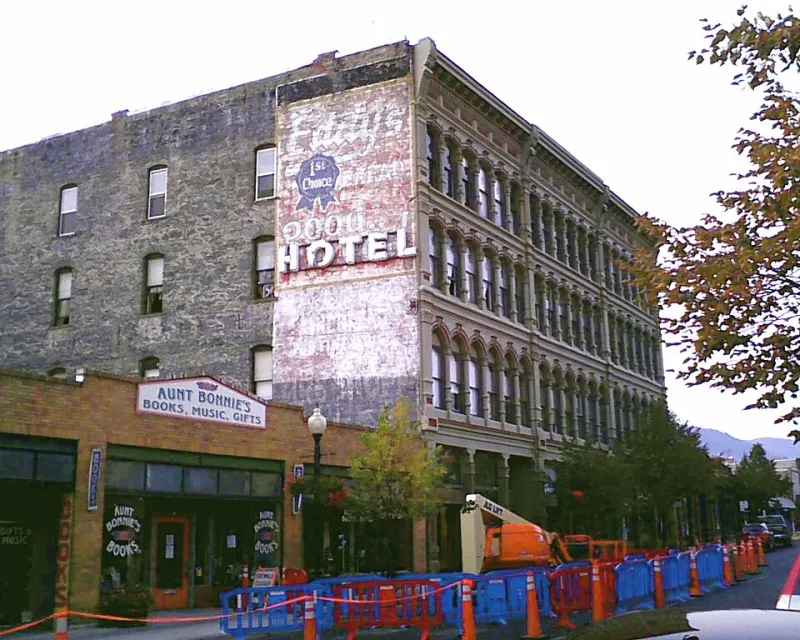
Photo: Montanabw, CC BY-SA 3.0, via Wikimedia Commons
There is a particular kind of looking that only happens when you stop trying to get anywhere. You glance up, above the charity shop and the vape shop and the neatly laminated menu of the café, and there it is: a pale strip of lettering on brick, advertising something that no longer exists. A grocer. A cycle agent. A brand of soap that your great-grandparents might have recognised without thinking.
These painted advertisements are often called ghost signs, which is a slightly theatrical name for something quite ordinary. They are not supernatural. They are just old paint, old brick, and a town’s commercial memory doing its best to stay visible. And once you start noticing them, the high street becomes a different place.
Start with a slow lap
You do not need special equipment. You need a pavement, a bit of patience, and the willingness to look above eye level. Most of us walk around at the height of shop fascias and bus-stop timetables. The interesting stuff is often a storey higher, or tucked along a side wall where a building once faced a busier road.
Try walking the same short stretch twice, once in each direction. Morning or late-afternoon light is best, when the sun is low and raking across the brickwork. Flat midday light hides texture. Raking light shows every ridge of paint and every place where the brick has shrugged it off.
A phone camera is useful, but use the zoom rather than leaning into private property. Stand on the public pavement, frame the sign squarely, and then look again without the screen. The camera is good at recording. Your eyes are better at noticing.
What you are actually looking at
Old shopfront advertisements were usually painted by hand, often by a signwriter working from a ladder with a mahl stick and a pot of one-shot enamel. Good signwriters understood letterforms in the way that good stonemasons understood stone. The letters were not simply enlarged type; they were drawn, spaced, and fitted to the wall.
That is why genuine old signs often have a slightly improvised confidence. A word may be compressed to fit a window opening. A border may stop short because a drainpipe got in the way. The lettering may be beautiful, but it is rarely perfect in the way that a computer layout is perfect.
Many walls carry more than one sign. A later trader painted over an earlier one, or a new advertisement was added beside an old one. Over decades, the top layer flakes away and the previous message reappears underneath. Conservation people sometimes call this a palimpsest, which is a lovely word for the simple fact that walls keep receipts.
The honest age test
Not every faded sign is old, and not every old sign looks ancient. A few practical clues help.
Genuine signs usually sit in the brick rather than on top of it. The paint has soaked into the surface, and the texture of the masonry shows through. Edges are feathered and irregular. Lichen may have moved in. Later repointing may cut across the lettering. A drainpipe, cable, window or doorway added long after the sign was painted will interrupt it without apology.
The fading is uneven in a way that follows the weather. One side may be bleached by sun; another may be streaked by rain running off a sill. Fixings for old signs may leave rust marks. Sometimes you can see the shadow of a removed fascia board or a bracket, a clean-ish rectangle on a dirty wall.
Modern pastiche tends to give itself away in the opposite direction. The edges are too crisp. The fade is too even, as if someone has applied a filter to real life. The lettering may be a modern typeface dressed up with a few curls. It may be printed on vinyl, or stencilled onto fresh render. The distressing often looks deliberate rather than earned, especially when it appears on a building that has clearly been recently renovated.
That said, a modern sign is not automatically a crime. Some owners commission careful hand-painted work in the spirit of the original, and some genuinely old signs are repainted to keep them legible. The interesting question is not simply old or new. It is whether the sign is trying to tell you something true about the building, or just borrowing the look of age for atmosphere.
Read the layers, not just the words
Once you have found a likely sign, look at the whole wall. Old advertisements rarely survive alone. They sit among blocked-up doors, changed window heights, different brick colours, and mortar repairs that mark decades of alteration.
A few things worth noting in your phone or notebook: the wording, the lettering style, any visible brand names, the position of the sign relative to windows and rooflines, and any later additions that cut across it. If there are two or three layers, try to work out which came first. The one underneath is not always the older one; sometimes a later sign was painted around an earlier one that the owner wanted to keep.
Do not scrape, rub, or pick at the paint. It is tempting to help a stubborn letter emerge, but you will only remove evidence. A soft brush is about as far as anyone should go without professional advice, and even that is best left to the building’s owner.
The trades behind the names
Part of the pleasure is the vocabulary. Painted walls often advertise the practical businesses that kept a town going: grocers, drapers, cycle agents, coal merchants, insurance agents, bakeries, boot repairers. You may find local names that mean nothing to you and everything to someone else’s family history.
National brands appear too, often as agent signs or depot advertisements. Soap, tea, tobacco, cocoa, patent medicines, ales. Some names have lasted; others have vanished so completely that you need a local-history library to place them. That is not a failure of memory. It is just how commercial life works. Shops close, brands merge, and the wall keeps a faint copy of the old conversation.
A note on manners
Most of these signs are on private property, even when they face a public street. Photograph from the pavement. Do not climb walls, move bins, or wander into yards. If a shop is open and you want a closer look, ask. People are often pleased that someone has noticed the old lettering above their stockroom, but they are less pleased by a stranger treating their building like a public exhibit.
If you own a building with a historic sign, get advice before repainting or rendering. Well-meaning improvement can destroy the very thing that makes the wall interesting. Local conservation officers and specialist signwriters can help you work out what is worth keeping and what is simply too far gone.
Look up, then walk on
You do not need to save every faded advertisement. Some are barely there. Some are modern indulgences. Some are on buildings that need new windows more than they need heritage interpretation.
But the habit of looking up is worth keeping. It slows a walk down. It turns a row of shops into a record of change. And it reminds you that the high street is not just a place to buy things. It is a place that has been written on, painted over, and written on again.
Next time you are waiting for a bus, or killing ten minutes before a train, try one slow lap of the nearest old street. Start above the shop signs. The wall may not have much to say, but it usually has something.