Welcome to Our Town (Population 4,200): In Praise of the Twinning Sign
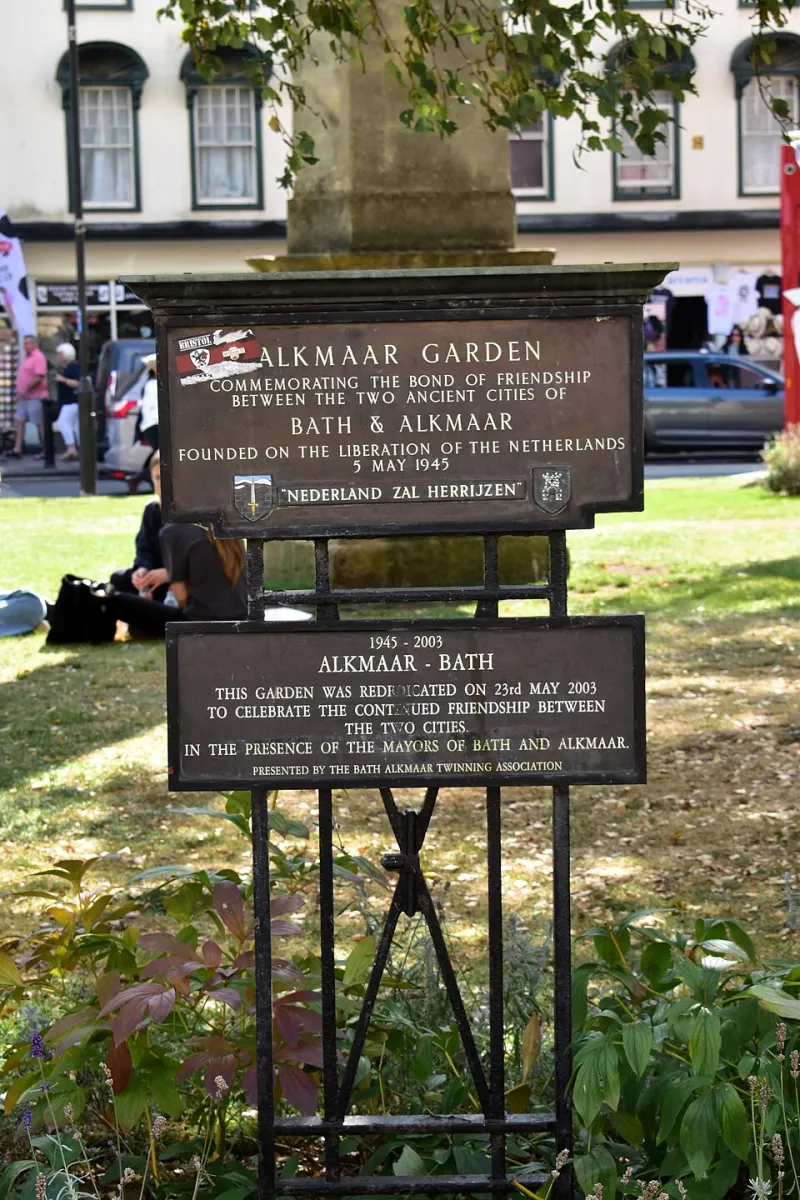
Photo: Bärbel Miemietz, CC BY-SA 4.0, via Wikimedia Commons
You know the sign. It's on the approach to town, roughly where the speed limit drops to 30, mounted on two slightly wonky posts. Below the name of the place you're entering, in a smaller and sadder font, is a line like Twinned with Sainte-Véronique-sur-Noire.
Nobody in the car reacts. Nobody ever reacts. And yet somebody, at some point, drove to France, drank a great deal of wine, signed a charter, shook hands with a mayor, and came home convinced that this was a thing worth putting on a sign.
I think they were right, and I think we should talk about it more.
The anatomy of a twinning sign
The classic format hasn't changed since about 1975. Town name in big letters. A line or two beneath, listing partners. Often a small crest. Frequently a European flag sticker that has been quietly fading since 2016 and which nobody has quite had the heart to remove, or the budget to replace.
There are variations. Some signs are elegant, stone-built and clearly the work of a council with ambition. Others are a laminated A4 sheet in a plastic wallet, cable-tied to a lamppost, listing three towns and a phone number for the parish clerk. Both are valid. Both say the same thing: we are connected to somewhere else, and we would like you to know.
Then there's the car-park monument. Every so often a twinning isn't marked by a sign at all but by a small granite block, a plaque, or — in one memorable case I came across in Lincolnshire — a piece of municipal sculpture involving a lot of welded steel and no apparent explanation. Nobody has looked at it since the unveiling. It remains magnificent.
How Britain ended up paired with half of Europe
The history is better than you'd think. Twinning as we know it began in earnest after the First World War as a gesture of reconciliation, and gathered pace after 1945, when town councils across Britain and Europe decided that the surest way to prevent another war was to make sure the mayors knew each other's first names.
By the 1960s and 70s it was a civic craze. Rotary clubs, church groups, schools and scout troops all got involved. Coaches full of councillors trundled across the Channel. There were exchange visits, awkward buffets, badly translated speeches, and a great many commemorative trees.
Membership has thinned since. The volunteers who run twinning associations are, by and large, of a certain age, and the annual subscription is a hard sell when the alternative is a weekend away that doesn't involve a formal dinner. But the signs remain, whether or not the association behind them still meets.
The oddest pairings
A highly unscientific tour of the ones that make me smile.
Dull and Boring. The Scottish village of Dull and the American town of Boring, Oregon, have been informally partnered since 2012, later joined by Bland in Australia. It began as a joke and became a genuine bit of civic identity, with road signs and merchandise and a certain amount of press attention. It is the twinning sign's finest hour.
The name-matches. Towns that found a partner purely because the names rhymed or alliterated. There is something gloriously unromantic about these. No shared history, no wartime reconciliation, just a clerk in 1983 noticing that both places contained the word "Milton".
The wildly mismatched. A market town of 6,000 twinned with a German city of 300,000. You can feel the imbalance in the sign. It's usually the smaller partner that keeps the flame alive, because they have more to gain from being noticed.
The ones nobody can pronounce. A Kentish village twinned with a Breton commune whose name contains three apostrophes. The sign's lettering has clearly been redone by hand at least twice.
The new wave. Since 2022 a number of UK towns and villages have twinned with towns in Ukraine — sometimes formally, more often in a spirit of solidarity, with aid collections and welcome schemes doing the actual work. You occasionally see these added to a sign in a fresh font that doesn't quite match the rest. It is, quietly, one of the more moving things on a British roadside.
The people behind the plaques
A few years ago I spent an afternoon with the secretary of a twinning association in a small town in the Midlands. She'd been doing the job for nineteen years. Membership had fallen from 140 to 31. The association had, at that point, £412 in the bank and a booking for a hall every second Thursday.
What kept it going, she said, was not the charter or the civic dinners. It was that her daughter had spent a summer with a family in the twin town in 1998 and still rang them at Christmas.
That's the whole case, really. The sign is the tip of the thing. Underneath it is a network of small, unglamorous, human exchanges that no one would ever think to photograph.
Why the signs matter more in 2026
We are, as a country, unusually good at declaring our local identity and unusually bad at explaining it. The twinning sign does both in about eight words.
It's also one of the last pieces of public art that isn't trying to sell you anything. It's not a marketing banner. It's not an advertisement for a retail park. It's a statement, made at some expense, that this place has a relationship with another place, and that both have agreed to think about each other occasionally.
You can read that as slightly quaint. I prefer to read it as a very British form of romanticism — the sort that expresses itself through laminated signage and a commemorative bench in a twinned park.
How to notice them properly
Next time you drive into a town you don't know, look for the sign. Look at the names. Look at the font. Look at whether the European flag has been removed, or faded, or argued over. Look at whether somebody has cleaned it recently, because that tells you everything about whether the association still meets.
And if you get the chance, go to the twin town. Stand by their sign. See whether they've kept their half of the bargain.
The sign is a promise in two languages. It would be a shame to stop reading it.