The Gate That Says After You: A Field Guide to Britain’s Kissing Gates
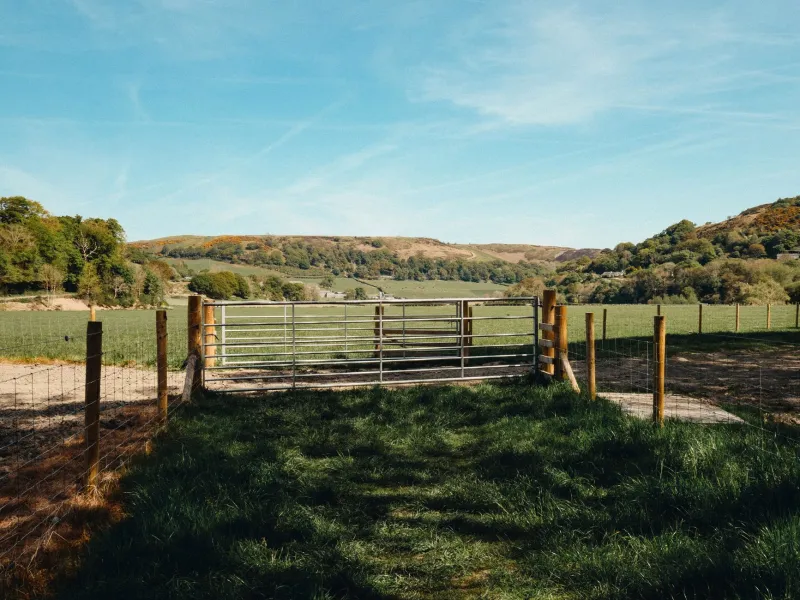
There is a particular sound to a kissing gate. Not a clang, not quite a click. More of a wooden knock followed by a soft settle, as if the gate has agreed to let you pass and would now like to get back to its own business. I heard it again last weekend on a footpath that ran between a hedge and a field of curious sheep, and it struck me that this is one of the few bits of British infrastructure that actually says after you.
A gate with no latch
A kissing gate does not have a latch. That is the first thing to understand about it, and the thing that makes it quietly clever. Instead of a catch or a handle, the gate swings inside a small enclosure — usually a V-shape or a U-shape — so that there is never a clear opening straight through. You step in, push the gate, step out the other side. The gate falls shut behind you under its own weight or a spring. A sheep cannot work the sequence. A cow certainly cannot. And because the gate never stands open, the field boundary stays intact.
It is a gate designed for one person at a time, which is either its great flaw or its quiet charm, depending on how much of a hurry you are in. The name is a small mystery. Some say it comes from the gate kissing the post as it swings shut. Others say it is something to do with the old word for a small gate or a gap. I have heard a farmer call it a kissing gate simply because you have to lean in close to use it. Whatever the root, the result is the same: a piece of people-sized engineering that asks you to slow down for a second.
The small print of the countryside
Kissing gates are the physical form of a compromise. On one side is a working field, with livestock that need to stay put. On the other is a public right of way, with walkers who need to get through. The gate is the handshake between the two. It is not a grand monument to access; it is a practical answer to a practical problem, and it has been adapted and rebuilt so many times that most of us pass through without giving it a second thought.
That is a shame, because the gate has plenty to tell you. A well-oiled hinge, a trimmed path, a fresh post — these are small signs that someone is paying attention. A gate that has been left to rust, or one half-swallowed by nettles, tells a different story. The countryside is not a museum. It is a working landscape, and the kissing gate is one of the places where work and walking meet.
A rough taxonomy of gates worth noticing
You do not need to become a gate spotter to enjoy this, but once you start looking you will notice the variations. A few types to keep an eye out for:
- The classic wooden V. Two angled rails, a wooden paddle, often oak or chestnut, weathered to a soft grey. This is the one most of us picture. It creaks in a reassuring way and usually has a muddy patch in front of it.
- The metal hoop. Galvanised steel, curved like a piece of abstract sculpture, common on paths where the wooden version would rot too quickly. It is efficient and slightly cold, but it does the job.
- The stone-slot gate. In upland areas, the gate is set into a drystone wall, with a small enclosure built from the same local stone. These feel less like street furniture and more like part of the geology.
- The long-handled paddle. A gate with a high handle so you can open it from either side without leaning over. Practical, slightly awkward, and a good reminder that not every design decision is about elegance.
- The adapted gate. Wider gaps, radar locks, smooth surfaces — attempts to make the kissing gate work for more people. Some are graceful. Some look as if a hospital trolley has been consulted. All of them are worth noticing.
The etiquette of the squeeze
The kissing gate has its own social rules, and they are mostly unspoken. One person at a time. Wait your turn. Do not hold it open for the whole group, because the whole point is that it closes. Step through, let it settle, then the next person follows. A nod is enough. A quiet thanks is better. If someone is coming the other way, you negotiate the little enclosure like two people passing in a narrow hallway: a half-step back, a small smile, a bit of mutual apology.
Dogs complicate things. Small dogs can be lifted. Larger dogs sometimes look at you as if you have personally designed the gate to be an insult. Bikes are worse. Backpacks are a nuisance. And yet the awkwardness is part of the point. The gate is a tiny rehearsal for a larger social idea: you can pass through a place without claiming it. You can be a visitor and still be careful.
A defence of the slightly inconvenient
I am not going to pretend that kissing gates are perfect. They are not always accessible. They can be a real barrier for wheelchair users, for people with limited mobility, for cyclists, for anyone pushing a buggy. A badly maintained gate is worse than no gate at all. The answer is not to rip them all out, though. The answer is to make the next generation better: wider where possible, smoother where needed, and designed with more than the able-bodied walker in mind.
But I would still defend the kissing gate as a piece of infrastructure that gets the scale right. It is small. It is local. It is made of materials that can be repaired by a person with a spanner or a hammer. It does not optimise you. It does not track you. It just asks you to come through one at a time, and in doing so it makes you notice where you are. On a weekend walk, that is no bad thing.
So next time you meet one on a footpath, take the half-second. Hear the knock and the settle. Say after you, even if there is nobody there. The gate has been holding the line between field and path for longer than most of us have been walking it, and it deserves a bit of respect.