The Box That Wouldn't Die: Britain's Tiniest Galleries and the Villages That Saved Them
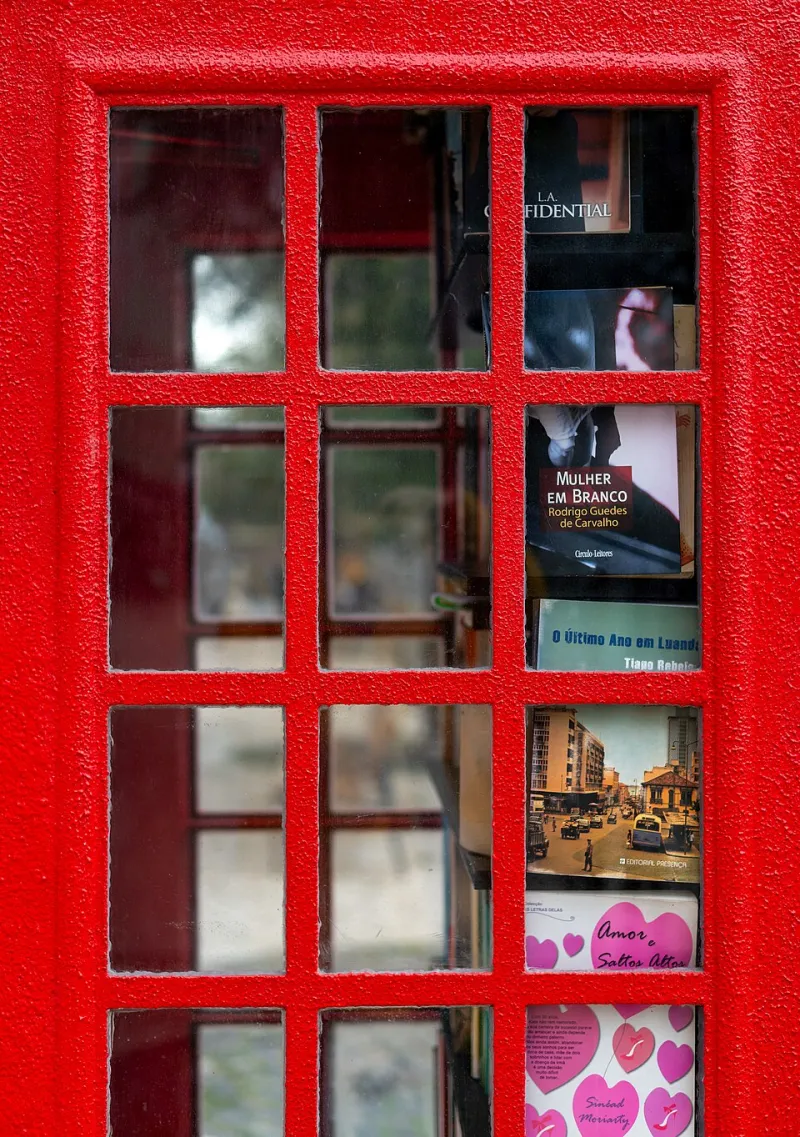
Photo: Jules Verne Times Two, CC BY-SA 4.0, via Wikimedia Commons
I found the gallery by accident, which is the only proper way to find a gallery in a phone box. It stood at a crossroads in a village I had no business being in, except that the lane looked interesting and the light was doing that soft, end-of-afternoon thing. The door was slightly ajar. Inside: six watercolours, a visitors' book, a jam jar of pencils and a handwritten notice asking me to close the door firmly because the hedge behind was nosy.
No handset. No dial tone. No emergency tuppence. Just a very small room with a very large sense of purpose. I signed the book, felt absurdly pleased, and walked on. That was the moment I started keeping a loose list of Britain's tiniest galleries — and the phone boxes that have refused to retire quietly.
The box that learned to listen
The red telephone box is one of those objects that became a symbol almost by accident. The K6, designed by Sir Giles Gilbert Scott and introduced in the 1930s, was a piece of civic furniture: sturdy, red, faintly ecclesiastical, built to be found. For decades it was simply where you rang home, rang the doctor, rang to say you'd missed the last bus.
Then mobiles happened. The boxes stopped earning their keep. Some were removed, some rusted in place, and some were adopted by communities through BT's Adopt a Kiosk scheme, which began in 2008 and allowed villages to take on a box for a nominal sum. Many are listed buildings. All are small. That last point turns out to be the useful one.
A phone box is not a shop, a hall or a museum. It is a cubbyhole with a door. That limitation has produced a remarkable range of second lives — not because villages had grand plans, but because they had a problem, a spare box and a willingness to try something slightly odd.
A light taxonomy of second lives
The library, no card required
This is the classic. Shelves go in, books appear, a laminated sign explains the rules: take one, leave one, keep them dry. The best ones have a tin for spare paperbacks and a faint smell of old paper and wet coat. The worst ones have a copy of a diet book from 2003 and a biography of someone you've never heard of. Both are part of the ecosystem.
What I like about the phone box library is its honesty. It does not pretend to be a library. It is a shelf with a roof, run on trust and mild guilt. If you take a book and forget to bring one back, the box does not send a letter. It simply waits.
The gallery, six visitors max
These are my favourites, partly because they are so unlikely. A village art group needs a wall. The phone box has walls. The result is a miniature exhibition space with a private view that consists of a flask and a packet of biscuits. You stand inside, turn slowly, and realise you are having a one-person culture moment in a space the size of a wardrobe.
Good phone box galleries have a theme. Bad ones have too many paintings. The best have a visitors' book, because the visitors' book is where the real work happens: 'Lovely colours.' 'Came for the walk, stayed for the painting.' 'Is the fox for sale?'
The defibrillator cabinet
This is the least whimsical conversion, and the most important. A red box becomes a green-lit cabinet, or keeps its red coat and gains a yellow sign. Inside is a piece of equipment that can restart a heart. It is not charming in the way a seed swap is charming. It is simply necessary.
What I notice is how often these boxes sit at the centre of a village, not at the edge. They are close to the pub, the green, the noticeboard. The old phone box was placed where people passed. That logic still holds.
The seed swap
A seed swap is a library with better smell. Envelopes, labels, a biscuit tin for donations, a few pencils on string. You take some runner bean seeds, you leave some marigold seeds, you go home and pretend you are organised. The phone box becomes a tiny agricultural exchange, which is a very British kind of optimism.
The wildcard
Every county seems to have one. A museum of local fossils. A display about a forgotten railway. A single lawnmower spark plug with a typed explanation. A box painted to look like a book. A box containing a miniature Christmas scene in July. The wildcard is the proof that the phone box is not a format. It is a prompt.
What the tiny gallery gets right
Smallness is not a limitation here; it is the point. A phone box gallery cannot overwhelm you. It cannot upsell you. It cannot keep you for two hours. You step in, you look, you step out, and the day is slightly different.
There is also a quiet lesson in adaptive reuse. Not every old thing needs to become a boutique hotel or a heritage experience with a car park. Sometimes a box can stay a box and simply do something else. The villages that have made this work are not showing off. They are solving a small problem with the materials at hand, which is roughly what ingenuity looks like when nobody is filming it.
And there is trust. The books are not chained. The seed envelopes are not locked. The visitors' book is not monitored. The whole enterprise runs on the assumption that most people are decent, and that assumption is usually correct.
Field notes for your own tiny tour
You do not need a map. Look for the red box at the crossroads, the one with a notice taped inside the glass. Try the door gently; some stick in wet weather. Sign the visitors' book if there is one. Do not take the last book unless you have a replacement. Do not block the defibrillator with your bike. Close the door firmly, because the hedge behind is nosy.
A phone box gallery is not a destination. It is a punctuation mark on a walk. It rewards the slow traveller who is willing to stop for something that cannot possibly take long, and then takes a little longer anyway.
In 2026, the phone box is less a relic than a prompt. It does not ring. But it still answers something — a need for a wall, a shelf, a shared space, a small red door that says: go on, have a look. The box that wouldn't die has found a new way to be useful. And in a country full of quiet corners, that is a very good thing to be.